
Learning Platform for Companies: Providers and LMS Compared
Digital Continuing Education for Your Team
You are looking for a learning platform for your company? The key is whether you want to buy ready-made online courses, organize your own training, or combine both. Here you can compare content providers and learning management systems (LMS), their pricing models, and the criteria for your selection.
Which Learning Platform Fits Your Company?
Start with a specific learning goal. For onboarding, you need your own content, clear learning paths, and role-based assignments. For professional continuing education, suitable courses and their practical relevance matter. For recurring training, you should check deadlines, reminders, and exportable participation reports in a demo.
- Small businesses: Ensure easy setup, low minimum commitment, and little administrative overhead. Check who internally manages content and user accounts.
- Medium-sized businesses: Compare roles and permissions, own learning content, interfaces to HR management, and the effort for ongoing operations.
- Internationally distributed teams: Check the actually available course languages, single sign-on, regional support, and evaluation across multiple locations.
For your shortlist: Test a typical training with a small group from the first login to completion. Then have a quote created with the same number of users, contract duration, and scope of services. This way you compare total costs instead of individual entry prices.
Content provider or learning platform? The two types of providers
In corporate e-learning, there are two types of providers that are often mixed up in marketing. One type delivers content – ready-made courses, videos, microlearnings. The other delivers software to distribute content, document mandatory training, and evaluate learning progress. If you need both, you either buy from a provider that offers both, or connect the courses via SCORM, xAPI, or LTI to your own system.
- Content provider – produces and licenses courses (Masterplan, PINKTUM, GoodHabitz, ZEIT Akademie). Billing is usually per person per year, often with a minimum commitment.
- LMS (Learning Management System) – the administration software: assign courses, monitor deadlines, document participation in an audit-proof manner. A must-have as soon as training sessions need to be verified.
- LXP (Learning Experience Platform) – builds on an LMS and focuses on recommendations, search, and learning paths. Useful from a library that no one can keep track of anymore.
This is connected via standards: SCORM is the classic for course import, xAPI also records learning activities outside the LMS, LTI integrates external platforms. More in the E-Learning Lexicon.
The best e-learning providers for companies at a glance
Ten providers that regularly appear on the shortlist in German-speaking countries – sorted by the breadth of their offering for companies, not by a rating. The order is not a ranking: A provider for data skills cannot be meaningfully compared against a soft skills library.
| Provider | Short profile | Price | More info |
|---|---|---|---|
 MasterplanGerman market leader |
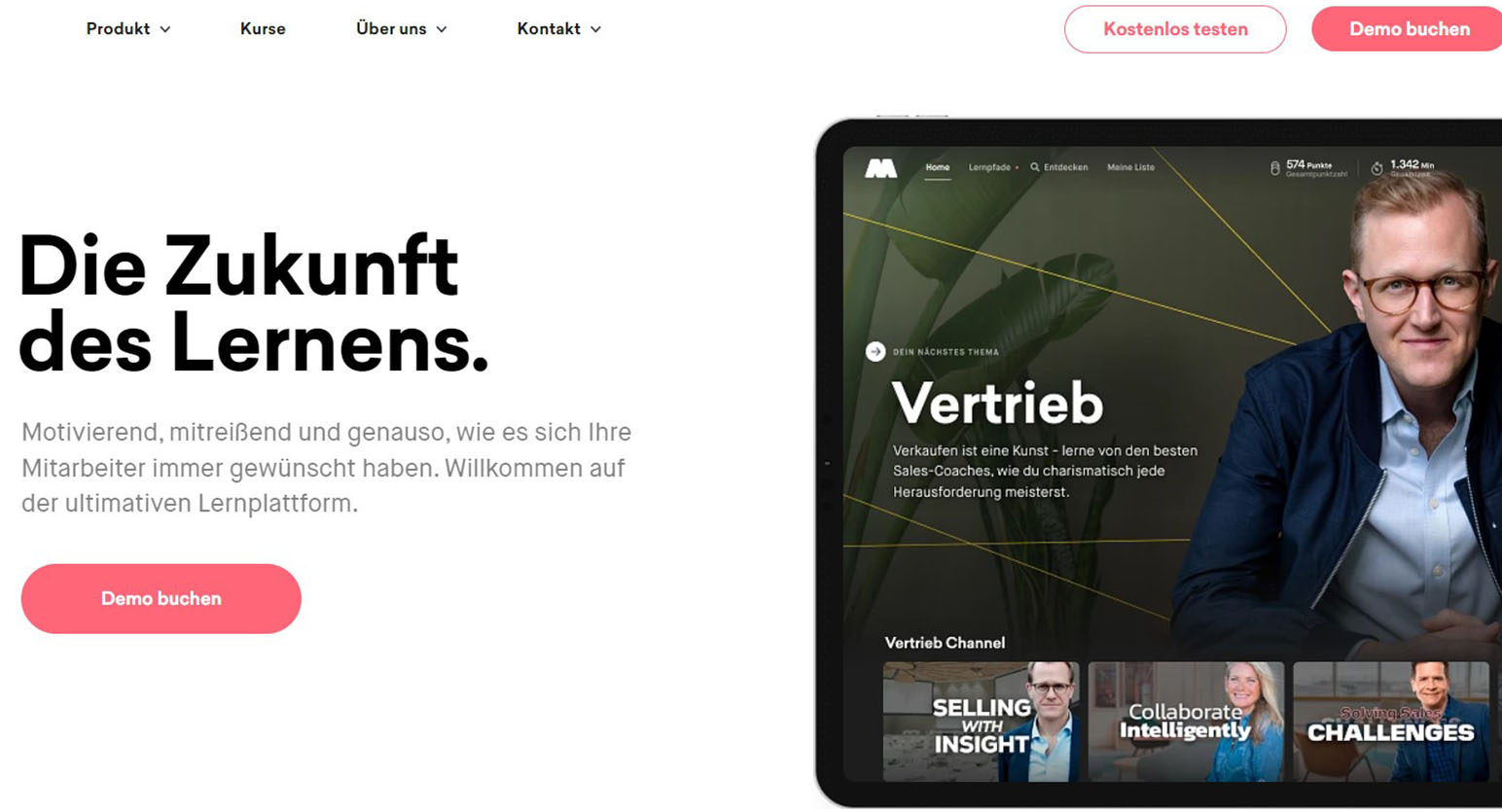
Learning engagement platform from Bochum with over 3,500 video courses in 26 languages and more than 300 customer companies, including VW, the Otto Group, and DZ Bank. Since September 24, 2025, Masterplan belongs to the Amadeus Fire Group.
|
on requestLicense per employee per year, with tiering based on company size | To profileTo provider |
 Haufe AkademieContent and platform from a single source |
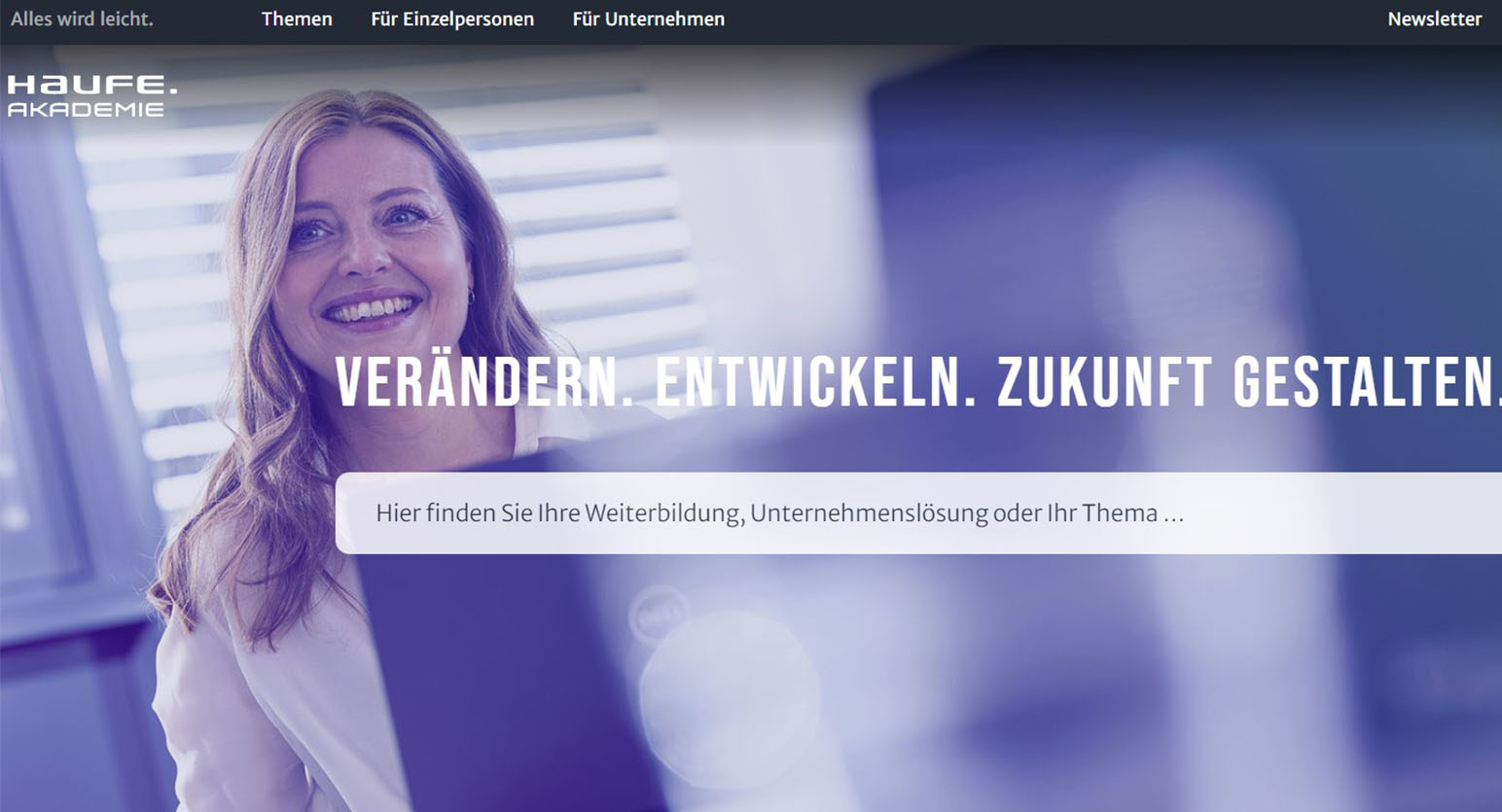
The largest German continuing education provider: over 3,600 continuing education courses in 26 subject areas, approx. 690,000 learners per year, and more than 6,300 in-house trainings in 2026 alone. The Digital Suite includes an LMS, an LXP, and a Content Kit with microlearnings.
|
on requestOpen seminars also bookable individually; Digital Suite as annual license | To profileTo provider |
 LinkedIn LearningBroadest business library |
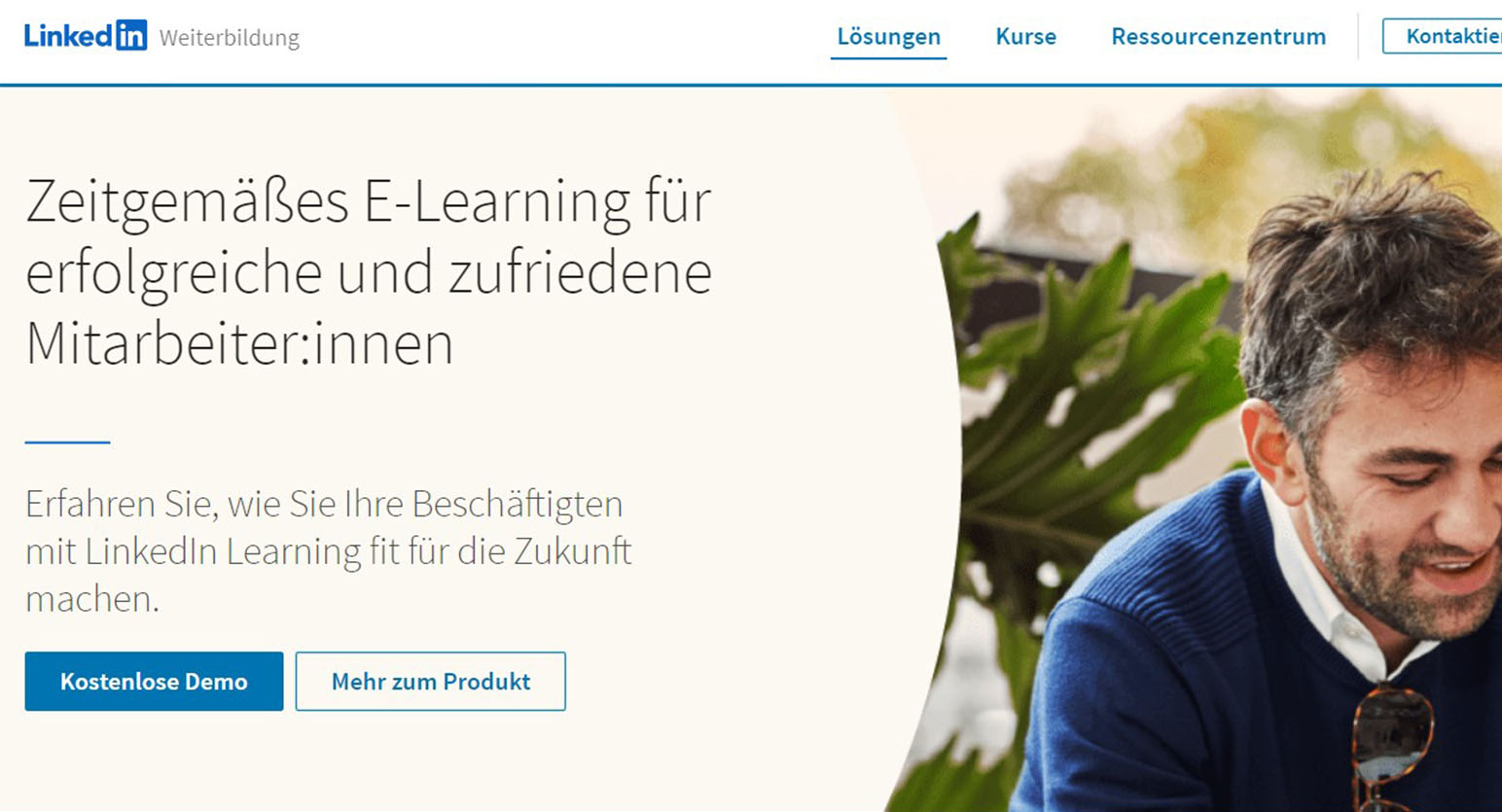
Over 21,000 courses in 25 languages, of which more than 2,500 in German – from Excel and SAP to project management and leadership. The Learning Hub supplements the library with an LXP into which content from third-party providers and from your own LMS can be integrated.
|
on requestTeam and enterprise licenses through sales; individual subscription for comparison approx. €20/month with annual subscription | Experience reportTo provider |
 PINKTUMSoft skills, accessible |
The provider from Munich and Hamburg (formerly Pink University) now offers more than 1,300 e-trainings on leadership, communication, and collaboration. The offering is structured as a learning journey: skill check, 60-minute trainings, microlearnings, and the AI coach PINKpro.
|
on requestLicense packages per user per year; individual trainings can be added via marketplaces | To profileTo provider |
 GoodHabitzFlat rate for the entire workforce |
Dutch provider with content in over 20 languages and 25 learning formats – from videos to tests to workbooks. Billed as a flat rate for the entire offering, not per course.
|
Flat rateFixed annual price based on company size, no limit on number of courses | To profileTo provider |
 ZEIT AkademieHigh-quality production |
The continuing education offering of the ZEIT publishing group: courses with scientists, journalists, and practitioners on leadership, digitalization, communication, and personality. For companies, the editorial team produces custom formats with in-house experts on request.
|
on requestCorporate licenses and individual courses; for comparison, private access at €19.99/month in annual subscription | Experience reportTo provider |
 Udemy BusinessLargest catalog |
The curated corporate catalog of the world's largest course marketplace: over 30,000 courses in 16 languages, used by approx. 18,000 companies. Since May 11, 2026, Udemy belongs to Coursera; the platform continues with its own catalog and own login.
|
from approx. $360 / user & yearTeam plan for small groups; Enterprise from 20 users individually (market data: $240–600 per seat) | Experience reportTo provider |
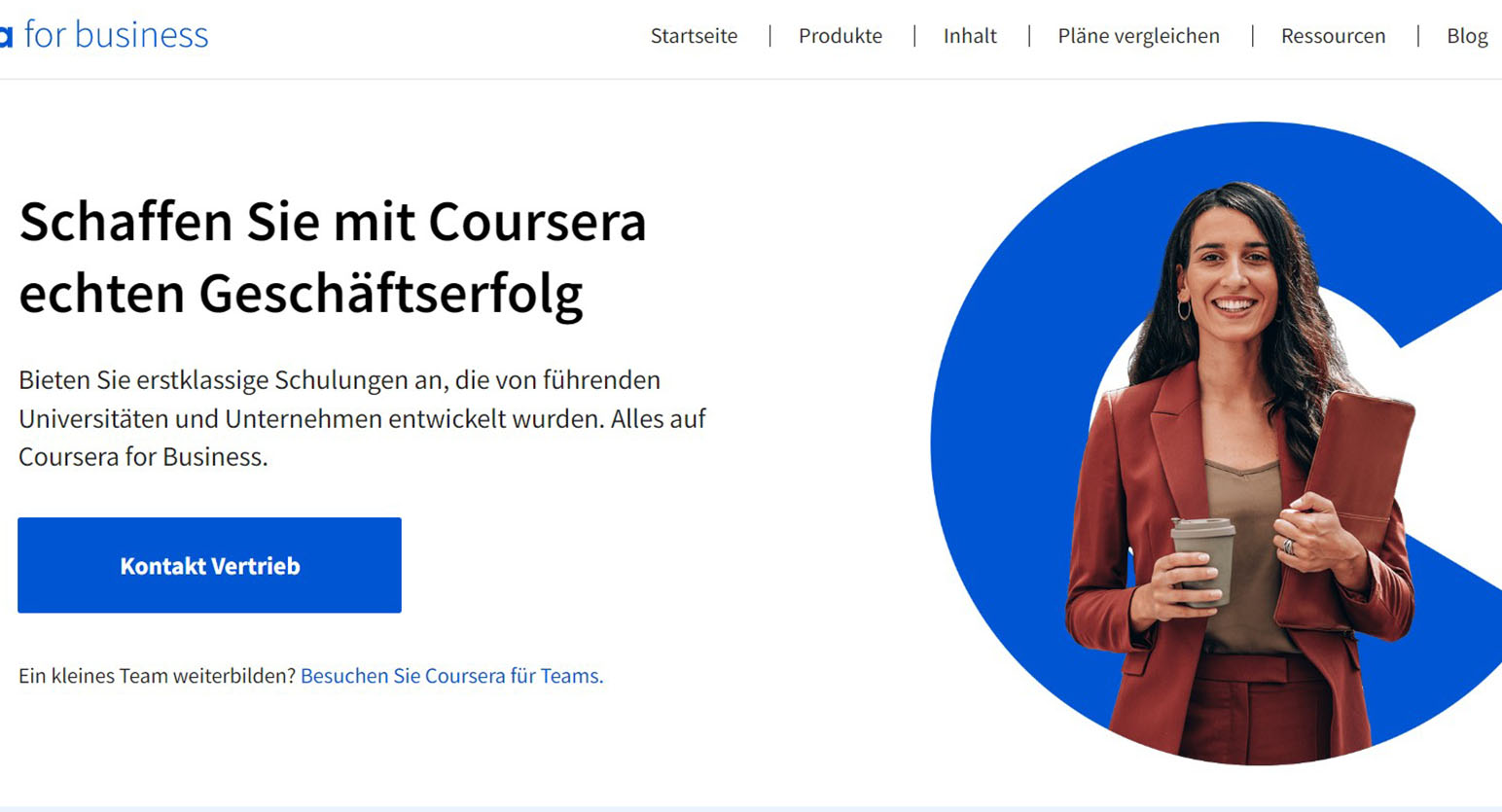 Coursera for BusinessUniversity courses & professional certificates |
Courses from universities and corporations, plus the Professional Certificates from Google, IBM, Meta, and Microsoft. After the merger with Udemy, the group counts over 290 million learners – the only provider in the field with real university degrees in its program.
|
$399 / user & yearTeam plan from 5 seats (min. $1,995/year), up to 125 users; beyond that Enterprise on request | Experience reportTo provider |
 StackFuelData and AI, with funding |
Berlin-based specialist for data and AI skills with more than 8,500 graduates and a completion rate of 93 percent. The programs are AZAV-certified and therefore eligible for funding via Bildungsgutschein (education voucher) and the Qualification Opportunities Act. Since January 2026, StackFuel belongs to the British provider Multiverse.
|
eligible for fundingUp to 100% via Bildungsgutschein (education voucher) or QCG; company quotas on request | View profileGo to provider |
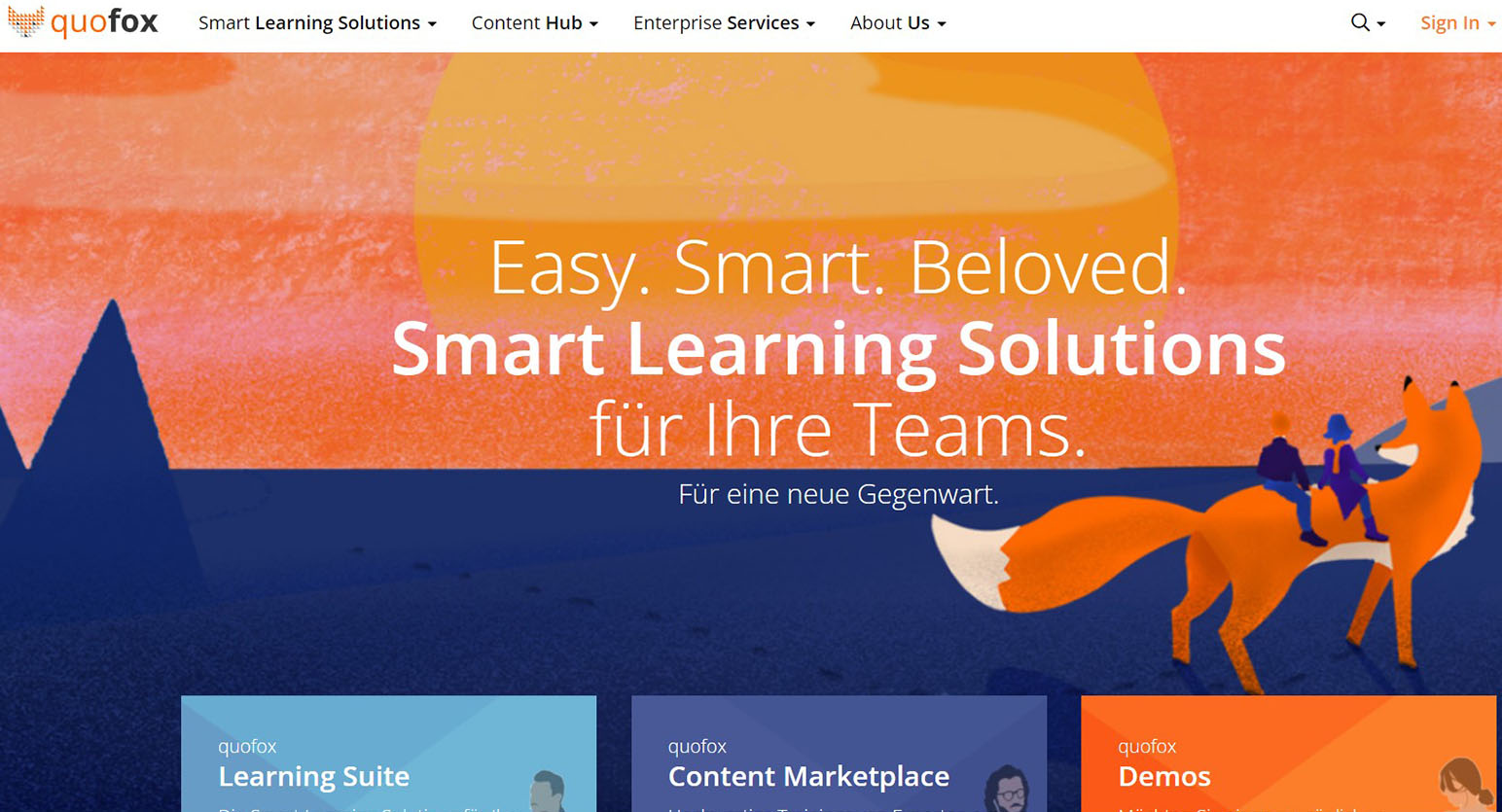 quofoxMarketplace instead of own library |
The Berlin-based quofox GmbH combines a course marketplace with offerings from external providers – Bitkom Akademie, Lecturio, TÜV Rheinland, ZEIT Akademie – with its own quofox Learning Suite as an LMS. Since July 2023, the company has been part of the Dutch Archipel Academy, which continues the offering in the DACH region.
|
on requestCourses are billed individually, the LMS as an annual license | View profileGo to provider |
As of August 2026. I checked all figures on the manufacturers' websites. Prices are almost always negotiable in B2B business; the information here is list prices or market data for orientation.
If you're not looking for any of the ten providers but for a specific course: In the course database for online continuing education you can filter by topic, qualification, and funding eligibility. If you prefer to ask rather than click, the AI search can help you.
Masterplan
German market leader
- OfferingsOver 3,500 video courses in 26 languages
- FocusLeadership, change, and soft skills
- CustomersOver 300 companies, including VW, Otto Group, and DZ Bank
- TechnologyOwn content via SCORM, integration with common HR systems
- SecurityISO and TISAX certified
- PriceOn request, license per person per year
- OwnerAmadeus Fire Group, since September 24, 2025
Masterplan started in 2017 in Bochum, founded by Stefan Peukert. Today it is the best-known German provider for corporate learning. In addition to experts, well-known names are in the catalog. Simon Sinek explains "The Power of Why," lawyer Christian Solmecke explains the General Data Protection Regulation.
What convinces me less is the prominence than the tools around it. You upload your own presentations as a SCORM package and connect the platform to your HR system. Amadeus Fire valued the company at around 20 million euros when it was acquired. For customers, nothing changes for now.
My impression: The first choice if your workforce learns in German and it's about leadership. For technical depth, you need a second provider.
Haufe Akademie
Content and platform from a single source
- OfferingsOver 3,600 continuing education courses in 26 subject areas
- ReachApprox. 690,000 learners and over 19,000 events per year
- FormatsIn-person, live online, e-learning, and in-house
- PlatformDigital Suite with LMS, LXP, and Content Kit
- In-houseMore than 6,300 company trainings in 2026 alone
- PriceOn request, open seminars also bookable individually
- HeadquartersFreiburg, founded 1978, approx. 680 employees
The Haufe Akademie is the broadest provider in the field. It is also the only place where in-person seminars, live online training, e-learning, and a learning platform come from the same house. This is supported by over 2,600 trainers.
Digitally, everything runs via the Digital Suite. The Learning Management System covers mandatory training and certifications, the Learning Experience Platform covers voluntary learning. If you're missing a topic, the academy produces it on request.
My impression: Strong if you want everything from a single source. Honestly, without a consultation, you'll hardly find your way around the portfolio.
LinkedIn Learning
Broadest business library
- OfferingsOver 21,000 courses in 25 languages
- In GermanMore than 2,500 courses
- PlatformLearning Hub as LXP, integrates content partners and your LMS
- ExtrasApp with offline mode, completion optionally shown on profile
- PriceOn request, individual subscription for comparison approx. 20 euros/month
- CatchLearning data is stored with Microsoft, access is lost after contract ends
LinkedIn Learning brings the largest general business library with it. For companies, there is also the Learning Hub, a learning experience platform. It focuses on learning progress, skill profiles, and personal recommendations. In it, you can also show content from content partners and from your own LMS.
The big advantage is also the biggest disadvantage. Because the platform is tied to the career network, you can find courses quickly and make completions visible with one click. However, all learning data is stored with Microsoft. How the platform performs in everyday use is covered in the LinkedIn Learning review.
My impression: Good for breadth and self-service. For mandatory training with proof, you still need your own system.
PINKTUM
Soft skills, accessible
- OfferMore than 1,300 e-trainings
- FocusLeadership, communication, conflict, collaboration
- StructurePINKprofile check, PINKmacro at 60 minutes, PINKmicro, AI coach PINKpro
- AccessibleVideo learning partner of the "BIK für Alle" initiative
- TechMultilingual, SCORM import into your own LMS
- PriceOn request, license packages per user per year
- LocationMunich with studios in Hamburg, founded 2010
PINKTUM is the brand of Pink University GmbH. The provider focuses on what is hardest to learn on the side. Namely, leadership, communication, conflict, and collaboration. The catalog is structured as a learning journey, from needs assessment to AI coach.
A special feature has gained weight in 2026. PINKTUM produces accessible content and is a video learning partner of "BIK für Alle". Since the Accessibility Reinforcement Act came into effect, this is no longer a nice-to-have for many companies.
My impression: The cleanest production in the field. You have to buy specialist and IT topics elsewhere.
GoodHabitz
Flat rate for the entire workforce
- OfferManageable library in more than 20 languages
- FormatsUp to 25 per topic, from video to test to workbook
- PriceFlat rate, fixed annual price based on company size
- SecurityISO 27001 and ISO 27701
- TechConnection to your own LMS via LTI or SCORM
- StrengthInternational workforces
- LocationNetherlands
GoodHabitz takes a different approach than most. Instead of stacking the largest possible catalog, it offers a manageable library. But you get each topic in up to 25 learning formats. I like the idea behind it: if you can choose the format, you are more likely to stick with it.
Billing is done as a flat rate, i.e., a fixed annual price based on company size. This makes calculations easy. It takes the discussion away from your HR department about who gets which course.
My impression: Ideal if everyone should get access and no one knows in advance who needs what.
ZEIT Akademie
High-quality production
- PublisherZEIT publishing group
- TopicsLeadership, digitalization, communication, methods, personality
- StructureShort lessons with quiz questions and graphics
- TechCourses via SCORM or MP4 into your own LMS
- ExtraCustom formats on request, e.g., interviews with management
- PriceOn request, private access for comparison 19.99 euros /month
- CatchSmall library, no offering for mandatory training
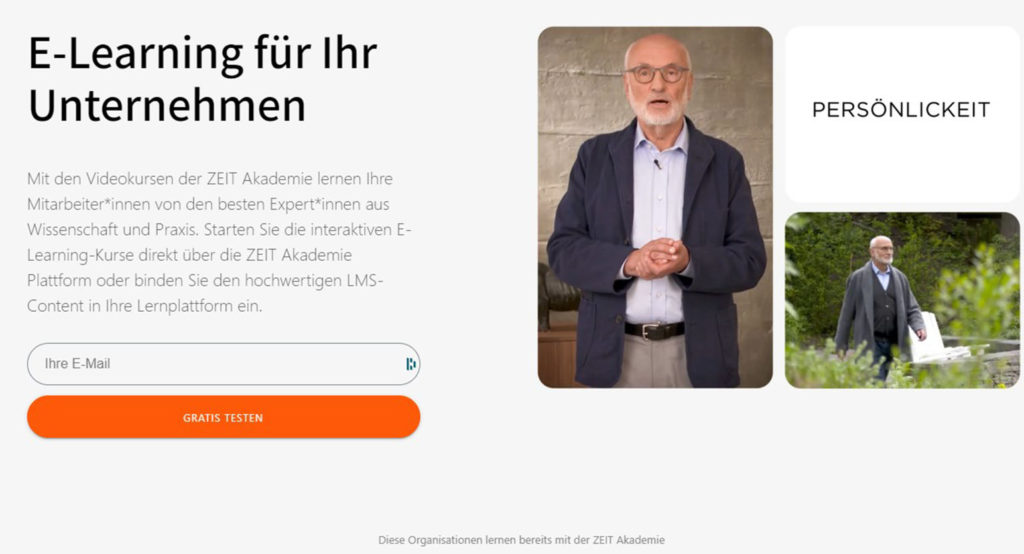
The ZEIT Akademie is the continuing education offering of the ZEIT publishing group. It relies on what a publisher does best: carefully produced content with recognized experts from academia and practice.
For companies, there are two ways. You use the ZEIT Akademie learning platform or bring the courses into your own system via SCORM. Additionally, you have the option to have custom formats produced. What the courses look like in terms of content is shown in the ZEIT Akademie review.
My impression: A good choice for leadership programs. As basic coverage for the entire workforce, the library is too small.
Udemy Business
Largest catalog
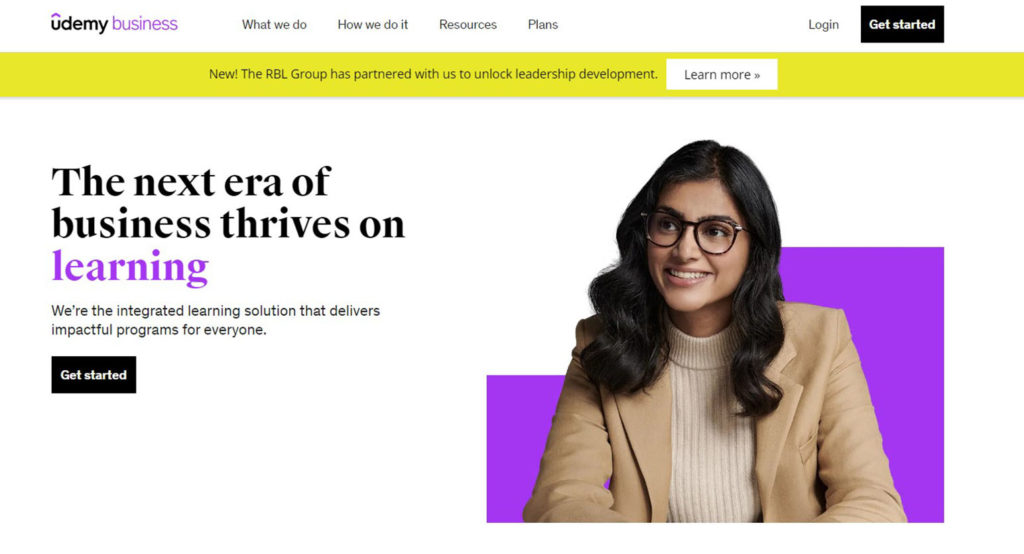
- OfferOver 30,000 curated courses in 16 languages
- SelectionFrom approx. 290,000 courses on the open marketplace
- CustomersApprox. 18,000 companies
- ExtrasLearning paths, user management, and analytics
- PriceFrom approx. 360 dollars per user per year
- OwnerCoursera, since May 11, 2026
- CatchQuality varies, certificates only prove participation
Udemy Business is the curated segment of the large Udemy marketplace. From around 290,000 publicly sold courses, the provider selects those that meet its quality and relevance criteria.
Its strength lies in speed. New tools, frameworks, and AI models are often available as courses just a few weeks after release. Publishers are still producing then. The price for this is uneven quality. Hands-on experience with the platform can be found in the Udemy review.
My take: Unbeatable for IT and software. How the catalog develops after the Coursera merger remains to be seen.
Coursera for Business
University courses and professional certificates
- OfferCourses from universities and corporations, plus entire online degree programs
- CertificatesProfessional Certificates from Google, IBM, Meta, and Microsoft
- StrengthData, AI, and IT fundamentals
- Price399 dollars per user per year, from five seats
- LanguageMostly English, German usually only as subtitles
- GroupUdemy has also been part of it since May 11, 2026
- CatchTeam plan ends at 125 users, above that Enterprise on request
Coursera is the only provider on this list whose certificates carry weight outside your company. The Professional Certificates from Google, IBM, Meta, and Microsoft are a selling point in job applications. For small teams, there is a real list price instead of a quote.
The catch for German workforces is the same as in the private sector. The catalog is mostly English-language; German is usually only available as subtitles. Anyone who needs courses in their native language often combines Coursera with a German provider. Details are in the Coursera review.
My take: The best choice if you want a certificate with external impact at the end.
StackFuel
Data and AI, with funding support
- ProgramsData Analyst, Data Scientist, Data Engineer, AI specialist, Python
- Hands-on80 percent exercises in a cloud-based programming environment
- SupportPersonal mentoring in feedback sessions
- Track recordOver 8,500 graduates, 93 percent completion rate
- FundingAZAV-certified, up to 100 percent in individual cases
- ReferencesBASF, BMW, Deutsche Bahn, Telefónica
- OwnerMultiverse, since January 2026
StackFuel from Berlin is not a library provider. Here you get a continuing education program with a beginning and an end. The courses consist of 80 percent practical tasks with real industry datasets. A completion rate of 93 percent is unusually high for online continuing education.
Important for financing: The programs are AZAV-certified. This makes them eligible for funding through Bildungsgutschein (education voucher) and the Qualification Opportunities Act, in individual cases up to 100 percent. Since January 2026, StackFuel has been part of Multiverse. The British provider wants to qualify 100,000 employees in Germany for AI topics.
My take: The only provider here where funding is realistic. On the other hand, it only covers one subject area.
quofox
Marketplace instead of its own library
- PrincipleCourse marketplace with external providers instead of its own library
- PartnersBitkom Akademie, Lecturio, TÜV Rheinland, ZEIT Akademie
- Platformquofox Learning Suite, modular LMS in your own corporate design
- FormatsIn-person courses alongside self-paced learning modules
- PriceCourses billed individually, the LMS as an annual license
- OwnerArchipel Academy, since July 2023
- CatchSome offers are only priced on request
quofox solves a problem many HR departments know. For every course, a separate contract, a separate invoice, a separate login. The Berlin-based provider instead combines a course marketplace with its own Learning Suite.
Since July 2023, quofox has been part of the Dutch Archipel Academy. The team in Berlin has become small since then. Anyone who bets on quofox should address the brand's future during contract discussions.
My take: Practical if you want to book many providers through one contract. Quality depends on the respective course provider.
Learning Management Systems (LMS) in Comparison
As soon as training must be documented – occupational safety, data protection, compliance, and from 2025 also AI skills – a course library is no longer enough. What you need is a system that assigns training, reminds you of deadlines, and records participation in an audit-proof manner. That is exactly the task of a Learning Management System.
The following selection covers the range actually used in German-speaking countries – from open source to enterprise. It is not a ranking: which system fits depends on company size, existing IT resources, and whether content is produced in-house or purchased.
| System | Short Profile | Operation & Costs | To Provider |
|---|---|---|---|
MoodleOpen Source, globally widespread |
By far the most widespread LMS, originally from the education sector. Moodle Workplace is the variant tailored to companies with organizational charts, certifications, and automated learning programs.
|
self-hostedSoftware free; costs arise for hosting, setup, and maintenance – usually via a certified partner | To Provider |
ILIASOpen Source from Germany |
An open-source LMS originating in Cologne, primarily used in universities, public authorities, and the German armed forces. Strong in exams, competency management, and formal certifications.
|
self-hostedLicense-free; support via partners or your own IT | To Provider |
imc Learning SuiteEnterprise from the DACH region |
One of the best-known corporate LMS from German-speaking countries, based in Saarbrücken. Designed for large organizations with complex role, certification, and compliance requirements.
|
on requestCloud or on-premises; price based on user count and modules | To Provider |
reteachFor small and medium-sized businesses |
Berlin-based SaaS learning platform from 2020, reportedly used by over 1,500 companies. Target group is SMEs and mid-sized companies that want to set up onboarding and mandatory training without an IT project.
|
SaaS subscriptionMonthly or annual license based on user count, hosting in Germany included | To Provider |
edyoucatedLXP with skill analysis |
Learning Experience Platform from Münster that focuses on competency-based learning: the system captures existing skills and suggests personal learning paths from them – using both own and purchased content.
|
on requestSaaS, price based on user count | To Provider |
360LearningCourses from the specialist department |
French platform with a Collaborative Learning approach: not HR produces the courses, but the experts themselves – with an authoring tool, comment function, and approval process.
|
on requestSaaS, billed by active users | To Provider |
DoceboInternational, AI-powered |
One of the most established international enterprise LMS, founded in 2005. Focus is on AI features: natural language search, automatically generated course modules, tests, and video presentations.
|
on requestSaaS, price based on user count and modules | To Provider |
Not in the table, but often part of the selection process: the Digital Suite from Haufe Akademie and the quofox Learning Suite – both interesting if you want platform and content from a single source. If you already use SAP SuccessFactors, Personio, or another HR system, first check the learning module included there: The worst solution is rarely the second-best system, but rather two systems without shared employee data.
How much does e-learning cost for companies?
In B2B business, there are hardly any price tags – billing is per person, per year, with discounts starting at a certain volume. Four models are common:
| Model | How billing works | Best suited if … |
|---|---|---|
| Per-seat license | Fixed amount per employee per year, usually with minimum purchase and tiered pricing. | … all employees should get access and the headcount is stable. |
| Flat rate | One annual price for the entire offering, regardless of the number of courses (e.g., with GoodHabitz). | … no one can know in advance who needs which course. |
| Individual booking | Per course and person, like on a marketplace (quofox, Haufe seminars). | … only individual people need very specific topics. |
| Platform + Content separate | LMS license based on user count, content licensed separately or created in-house. | … a lot of internal knowledge exists in-house and needs to be documented. |
What is often overlooked in quotes: Setup and data import, integration with the HR system, training for administrators, translations, and – the most expensive item of all – the working time spent learning. One hour of learning time per month per person costs a company with 200 employees more than any license. And another point for contract negotiation: With subscription models, nothing remains after the contract ends – if you need to keep records of completed mandatory training, clarify the export of learning history beforehand, not when canceling.
Funding: Who pays for continuing education?
Corporate continuing education is eligible for funding in Germany – but only with AZAV-certified providers. Classic subscription platforms like LinkedIn Learning or Udemy Business are therefore excluded; certified courses from providers like StackFuel or major continuing education providers are not.
- Qualifizierungschancengesetz (Section 82 SGB III). Subsidies for course costs and wages for employees whose jobs are changing due to technology. The amount depends on the company size – in micro-enterprises, up to 100 percent of course costs are possible.
- Qualifizierungsgeld (since April 1, 2024). For companies with qualification needs due to structural change: The Federal Employment Agency pays employees 60 percent of their last net salary (67 percent with children) during the continuing education, similar to short-time work benefits. The employer bears the course costs.
Requirements for Qualifizierungsgeld (qualification allowance): more than 120 hours of continuing education (not consecutively), a provider certified according to AZAV, and a works agreement or collective bargaining agreement that documents the need – at least 20 percent of the workforce must be affected (for companies with 250 or more employees) or 10 percent in smaller companies. For companies with fewer than ten employees, a written declaration is sufficient.
Both must be applied for before the start of the measure – if you book first and ask later, you'll come away empty-handed. The first point of contact is the employer service of the Federal Employment Agency. Funded courses can be found in the course database, and an overview of providers can be found under continuing education providers.
AI in Corporate Continuing Education 2026
The biggest change of the last two years isn't in the catalog, but in the way learning happens. In the trend study mmb Learning Delphi 2025/2026, for which 77 experts from the education sector were surveyed between December 2025 and February 2026, chatbots and AI learning assistants rank first at 95 percent among the learning formats that will become important in the next three years. The experts also expect large AI providers to take over tasks that were previously handled by traditional e-learning providers.
In practice, this means: Almost every corporate platform now has an assistant that answers questions about the course material, quizzes you, or generates exercises – at PINKTUM as a conversation coach, at Coursera as a learning companion, at Docebo as a search assistant. For HR development, this changes the task: no longer buying courses, but building AI competence and ensuring that the assistants are used for asking questions and not for cutting corners.
The second driver is legal. According to Article 4 of the EU AI Act, companies that use AI systems have had to ensure since February 2, 2025 that their employees have sufficient AI competence; national market surveillance for this has been running since August 2, 2026. No specific curriculum is prescribed, but the result – and the proof – are. This is exactly why basic AI training courses are currently appearing in every mandatory training catalog.
Obligations 2026: Accessibility, Data Protection, AI Competence
Three topics appear in practically every provider selection in 2026 – and are only expensive to fix later:
- Accessibility. The Barrierefreiheitsstärkungsgesetz (BFSG – Accessibility Reinforcement Act) has been in effect since June 28, 2025. It targets products and services for consumers, not the internal learning platform – but if you also deliver courses to customers, partners, or the public, you are within its scope. A transition period applies for existing services until June 28, 2028, and fines can reach up to 100,000 euros. Regardless of the legal situation: subtitles, transcripts, and keyboard operability benefit everyone – and are difficult to retrofit later.
- Data protection. An LMS processes employee performance data. A data processing agreement, a clarified server location, and – in companies with a works council – a works agreement that specifies which evaluations are permitted are necessary. Evaluations at the individual level are the most common point of contention during implementation.
- AI competence. See above: Article 4 of the AI Act requires trained employees, not just a policy. If you already document training, you should include basic AI training in your proof obligations catalog as well.
Seven steps to find the right provider
- 1. Clarify the reason. Mandatory training with certification, voluntary continuing education, or retraining? Everything else depends on this – only in the first case does the path necessarily lead through an LMS.
- 2. Count your target group. The entire workforce or 30 managers? Flat-rate models only pay off at scale.
- 3. Define languages. Production and administration often need different languages – subtitles are no substitute for a German-language version.
- 4. Check the technology. SCORM, xAPI, or LTI? And does the integration fit with the HR system that provides the personnel data?
- 5. Define certifications. Who needs to be able to prove what when – and how long will the data remain available after the contract ends?
- 6. Check funding beforehand. The provider's AZAV accreditation and the application must be submitted before the start, otherwise the subsidy is forfeited.
- 7. Test phase with real people. Not the sales department's demo, but ten employees, four weeks, then honest feedback. The dropout rate in the test says more than any course description.
Frequently Asked Questions about E-Learning for Companies
Further Reading
For personal continuing education instead of for the team: the big comparison of e-learning platforms. What the term actually means is explained in What is E-Learning?, and the abbreviations from this article – SCORM, xAPI, LXP, Blended Learning – are in the E-Learning Glossary.
Individual tests of platforms that are also interesting for personal use: LinkedIn Learning, Coursera, Udemy, and the ZEIT Akademie. Specific courses with certification are in the course database. For training your entire team, it's best to contact the provider directly.
I hope this overview helps with your selection. If a provider is missing or a detail has changed: feel free to write to me – the page is regularly updated.
 Article written by Tim Geier - about the author.
